 EN
 Deutsch
 Español
 Français
 Português
 Română
40 Gratitude Jar Ideas for Adults and How It Works
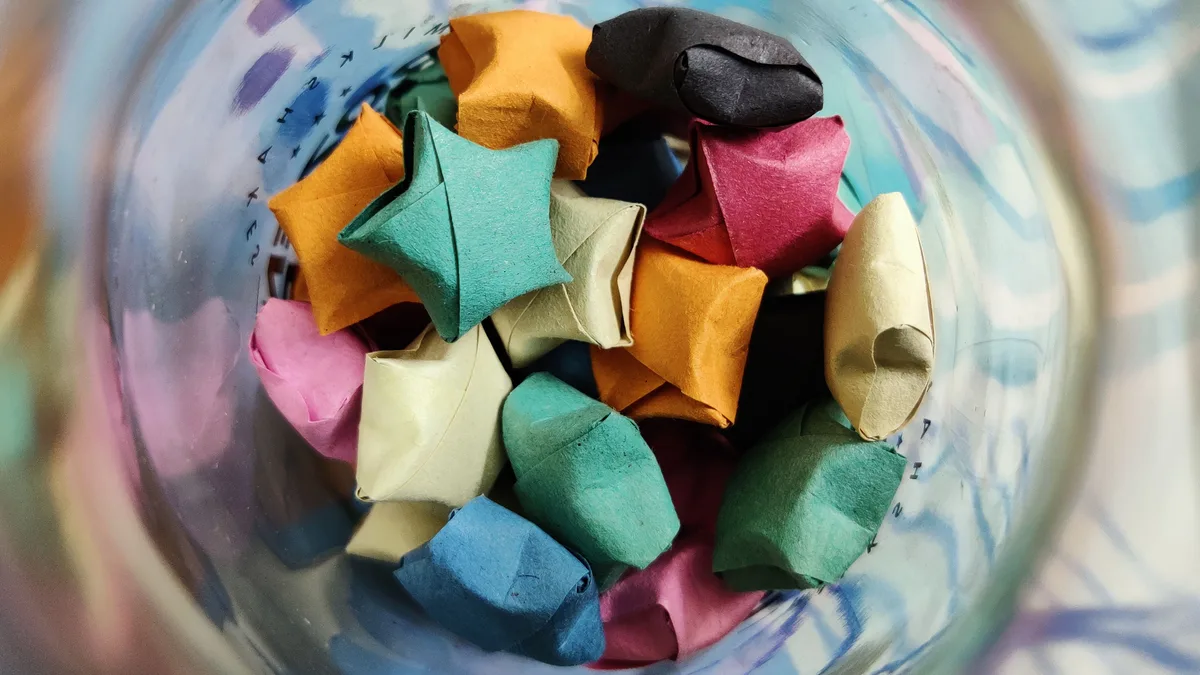
A gratitude jar is a jar where you drop short notes about good things that happened, then read them all at once on a date you choose, like the end of the month or New Year’s Eve. For adults it works well as a small routine: one note at a time, with the date and one specific detail. Below you’ll find how to make one in five steps, 40 ideas for what to write, ways to share a jar and what studies say about the habit behind it.
What is a gratitude jar?
A gratitude jar is a glass jar or another container that holds handwritten notes about things you’re thankful for. Each note names one good moment. The notes stay in the jar until a set day, when you open it and read them.
It’s a paper version of a gratitude journal. The difference is that you don’t reread the jar every day. You add to it and read it later, so most notes come back as small surprises. Some people call it a happiness jar.
How to make a gratitude jar in five steps
You need a jar, small pieces of paper and a pen. Making one takes a few minutes.
- Pick a jar. A clear jar with a lid works well, because you can see it fill up. A jam jar is fine.
- Cut the paper. Small squares or strips, about the size of a sticky note, fit through the opening once folded. Colored paper makes the jar nicer to look at but isn’t necessary.
- Keep the jar where you’ll see it. Next to your bed, on the kitchen counter or on your desk. Put the paper and a pen right beside it.
- Write one good thing and the date. One sentence is enough. Fold the note and drop it in.
- Choose when to open it. Write the date on a label or on the lid: the last day of the month, New Year’s Eve, your birthday.
What to write in a gratitude jar: 40 ideas for adults
The best notes are short and specific. “My friends” is true, but “Ana texted to check how my interview went” will mean more when you read it months from now. Use these 40 ideas as a starting point and change the details to fit your life.
Gratitude jar ideas for ordinary days
- The first sip of coffee, still hot.
- The bus came right as I reached the stop.
- Clean sheets tonight.
- A song I love came on in the store.
- Leftovers, so I didn’t have to cook.
- Ten quiet minutes before everyone woke up.
- The rain stopped just as I left the office.
- A good book I didn’t want to put down.
Gratitude jar ideas about people
- Mom called just to chat.
- Sam saved me a seat at dinner.
- A neighbor brought in my package before it rained.
- My partner made tea without me asking.
- A stranger held the door when my hands were full.
- Lunch with an old friend I hadn’t seen in a year.
- My sister sent me a photo from when we were kids.
- The pharmacist took the time to explain my prescription.
Gratitude jar ideas for work
- The meeting ended fifteen minutes early.
- My manager thanked me for the report in front of the team.
- A coworker covered my shift when I was sick.
- I finally fixed the problem I’d been stuck on all week.
- Lunch outside instead of at my desk.
- A client wrote back to say thanks.
- Friday afternoon with nothing urgent left.
- I learned a shortcut that saves me time every day.
Gratitude jar ideas about yourself
- I said no to something I didn’t have time for.
- I went for a walk even though I didn’t feel like it.
- I cooked a real dinner on a weeknight.
- I asked for help sooner than I used to.
- My knee didn’t hurt at the gym.
- I finished a book for the first time in months.
- I called to make the appointment I’d been putting off.
- I slept eight hours.
Gratitude jar ideas for hard days
On a bad day, the note can be very small. It only has to be true.
- The day is over.
- A hot shower.
- Someone brought soup and didn’t ask questions.
- The test results aren’t back yet, but the nurse was kind.
- I cried and felt a little lighter afterward.
- My dog was happy to see me.
- Tomorrow is Saturday.
- I got through it.
If hard days keep piling up, a jar of notes isn’t enough on its own. Talk to your doctor or a mental health professional.
For more ideas sorted by topic, see our list of things to be grateful for. If you prefer full sentences with the reason why, our gratitude journal examples show what that looks like.
Gratitude jar ideas for couples, families and work
A gratitude jar can be shared. Everyone writes their own notes, and you open the jar together.
- Couples. Each of you writes notes about the other: something they did, said or remembered. Reading them together at the end of the month means hearing what the other person noticed.
- Families. Keep the jar on the dinner table and let everyone add one note a week. Younger kids can draw instead of writing. Our Thanksgiving gratitude prompts include easy questions that also work as note ideas.
- Roommates or friends. A jar by the door collects good moments from the whole group. Open it at a dinner or a party.
- Work. A team jar in a shared space can hold thank-you notes to coworkers. Read them at the end of a project or at the last meeting of the year.
In a shared jar, agree before you start whether notes are signed and whether everyone reads them aloud or only the person they’re about.
When to open your gratitude jar
Choose the date before you start, so you know what you’re filling the jar for. Four dates work well:
- The end of the month. You get a small reward twelve times a year, while the month is still recent.
- New Year’s Eve. You read a whole year at once. For this date, start the jar on January first.
- Your birthday. It works the same way as New Year’s Eve, on a date that’s yours.
- A hard day. You don’t have to wait. Pulling out one or two notes on a bad day reminds you that good days happened too.
After you read the notes, keep them. An envelope with the month on it, or a notebook where you tape the best ones, lets you read them again years later.
Does a gratitude jar work?
We haven’t found a study that tested a gratitude jar specifically. The two parts of the habit, writing down good things and remembering them later, have been studied separately.
The first part is close to a gratitude journal. In the first study by Robert Emmons and Michael McCullough, published in 2003, 192 students wrote down up to five things they were grateful for once a week, for ten weeks. Compared with groups who wrote about hassles or ordinary events, they felt better about their lives as a whole and were more optimistic about the coming week.
The second part is remembering good moments. In two lab studies by Megan Speer and Mauricio Delgado at Rutgers University, published in 2017, some participants first went through a stressful task: holding a hand in ice water while being filmed. Among them, those who then recalled happy memories had a smaller rise in the stress hormone cortisol and less negative mood than those who recalled neutral ones. Reading notes from a jar is a way of recalling good memories, but nobody has tested the jar itself.
For more on what studies found and didn’t find, read our article on the benefits of gratitude journaling.
A gratitude jar on your phone
A jar of paper notes works well at home. It’s harder to keep up when you’re traveling, busy or away from the kitchen counter where the jar lives.
We built Graceup with its own Gratitude Jar. You write one good thing a day in about 30 seconds, and each entry drops into that month’s jar as a small colored note. The jar stays closed until the month ends, then you open it and read everything. Old jars stay on a shelf in the app, so you can open any month again.
Photo: steve o. george on Pexels
Frequently asked questions
What is the point of a gratitude jar?
A gratitude jar makes you stop for a moment to notice one good thing and write it down. Later, when you open the jar, you get to read all those moments together instead of forgetting most of them.
How often should you add to a gratitude jar?
There's no research-backed number for jars. One note a day is easy to remember if you tie it to something you already do, and one to five notes a week is closer to the weekly format Emmons and McCullough tested in their first study.
When do you open a gratitude jar?
Pick a date before you start: the end of the month, New Year's Eve or your birthday. On a hard day, you can also pull out a single note early.
What do you put in a gratitude jar?
Short notes on small pieces of paper, each with the date and one specific good thing, like "Lena brought me coffee before my 8 a.m. meeting." You can also add a ticket stub or a photo from a good day.
Is a gratitude jar only for kids?
No. Adults use it too, alone, as a couple or with roommates. The notes just change: work, friends, health and small things you handled well.
What can I use instead of a mason jar?
Any container with a lid works: a jam jar, a tin, a shoebox or an envelope. A clear jar has one advantage: you can see it fill up.
What do I do with the notes after I read them?
Keep them. Put the month's notes in an envelope with the date on it, or tape the best ones into a notebook, so you can read them again next year.

I'm Eric, and I want to help make the world a better place. Studies show that people who make gratitude a habit are happier, sleep better and are kinder to the people around them. I built Graceup so this habit is within anyone's reach.